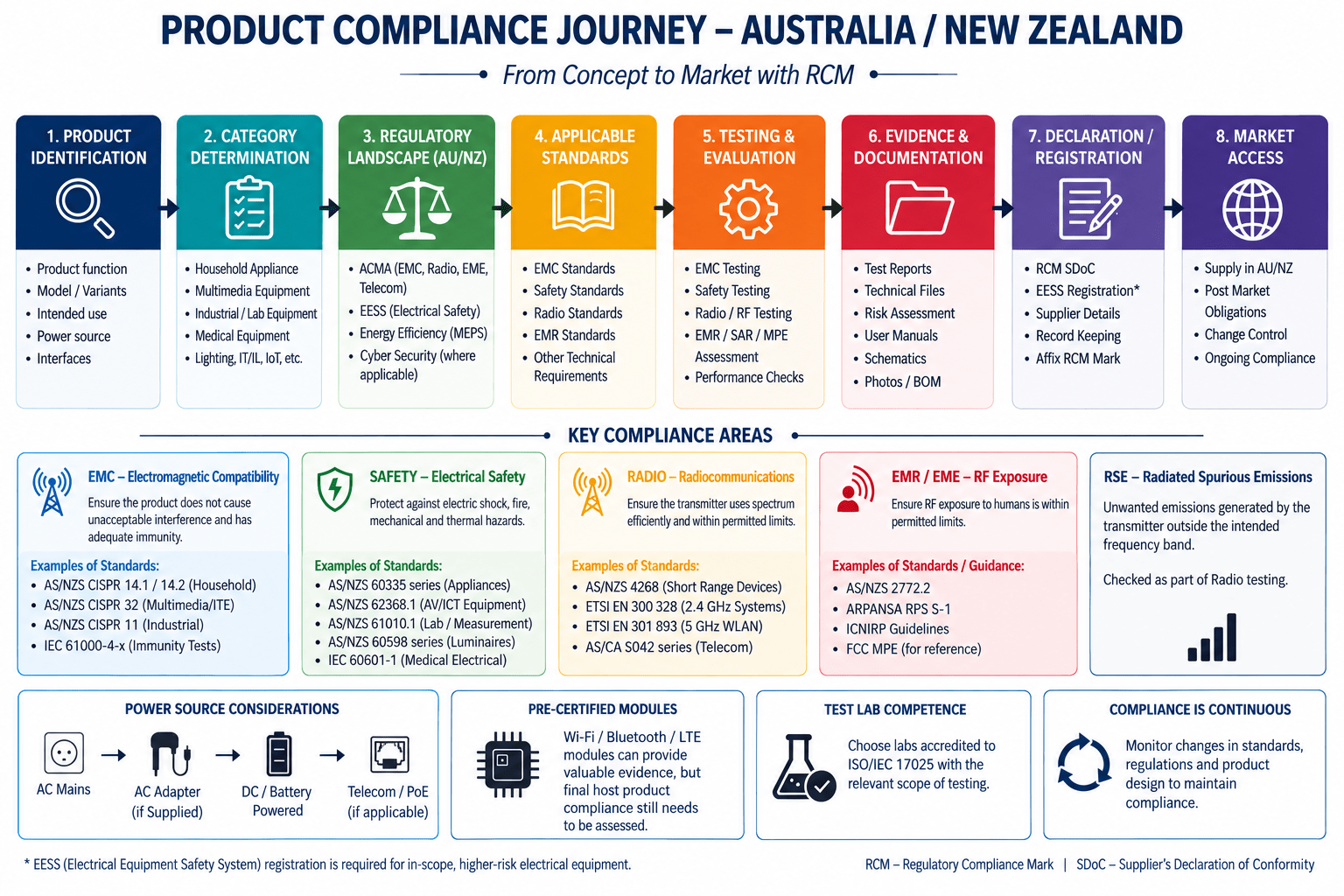
When a new electrical or electronic product is planned for the Australian or New Zealand market, one of the first questions is often:
“Which standards does this product need to comply with?”
From a compliance engineering perspective, that question comes slightly too early.
Before selecting a standard, we first need to understand the product, its category, its technologies, its intended use, and the market where it will be supplied.
A useful way of approaching the process is:
Product → Category → Country → Regulatory Requirements → Standards → Testing → Compliance Evidence → Declaration/Registration → Market Access
This simple sequence provides a useful framework for understanding product compliance.
Understanding the Product Comes First
Consider two products: a household coffee machine and an IoT gateway.
Both are electronic products, but their compliance requirements can be very different.
A coffee machine may need to be assessed as a household appliance, while an IoT gateway may fall within multimedia or information and communication technology equipment requirements.
If either product incorporates Wi-Fi or Bluetooth, radio and human RF exposure requirements may also become relevant.
Therefore, before reviewing test reports, a Compliance Engineer should understand:
- What is the product?
- What is its intended use?
- How is it powered?
- Is it connected directly to AC mains or through an external adapter?
- Does it contain a battery?
- Does it contain Wi-Fi, Bluetooth, BLE, cellular, NFC or another radio technology?
- Is it handheld, body-worn or normally operated at a distance?
- Is it intended for indoor or outdoor use?
- Which countries will it be supplied in?
Once these questions are answered, the applicable regulatory areas become much easier to identify.
EMC — Controlling Electromagnetic Interference
Electromagnetic Compatibility, or EMC, is one of the fundamental compliance areas for electrical and electronic equipment.
Every electronic circuit can generate electromagnetic disturbances. The objective of EMC requirements is to ensure that these disturbances do not exceed applicable limits and cause unacceptable interference.
Two terms frequently encountered in EMC testing are radiated emissions and conducted emissions.
Radiated emissions are electromagnetic disturbances emitted through the air, while conducted emissions are disturbances that travel through connected cables, such as power leads.
The applicable EMC standard depends on the product category.
For example, standards from the CISPR 14 family are commonly associated with household appliances, while CISPR 32 is widely encountered for multimedia equipment. CISPR 11 is another important standard encountered for certain industrial, scientific and medical equipment.
Immunity requirements may also be relevant depending on the product and jurisdiction. Common immunity test methods include electrostatic discharge, radiated RF immunity, electrical fast transients, surge, conducted RF immunity and voltage dips.
This demonstrates an important compliance principle:
The product category determines the applicable standard — not simply the fact that the product contains electronics.
Electrical Safety — Looking Beyond the Input Voltage
Electrical safety is another major part of product compliance.
Safety assessments can address hazards including electric shock, fire, excessive temperatures, insulation failure, mechanical hazards and abnormal operating conditions.
Different equipment categories therefore have different safety-standard families.
For example, household appliances commonly fall within the IEC/AS/NZS 60335 series, while audio/video and information and communication technology equipment may fall within the IEC/AS/NZS 62368-1 framework.
Laboratory and measurement equipment commonly involves the IEC 61010 series, while medical electrical equipment has the IEC 60601 series.
An important point for global compliance is that an international IEC standard and its national or regional adoption should not automatically be treated as identical.
A product tested against an IEC standard may still require consideration of the national differences applicable to Australia, New Zealand or another destination market.
This is why a Compliance Engineer does more than check whether a safety report exists. The report must be assessed for its relevance to the product, model, standard edition and destination market.
Radio Compliance — When the Product Intentionally Transmits
Modern products increasingly contain wireless technologies such as:
Wi-Fi, Bluetooth, BLE, Zigbee, NFC, RFID, LTE and 5G.
Once intentional radio transmission is introduced, radio spectrum requirements need to be considered in addition to conventional EMC requirements.
Radio compliance can involve parameters such as:
- Operating frequency
- RF output power
- Occupied bandwidth
- Unwanted emissions
- Spurious emissions
- Antenna characteristics
- Frequency-specific operating conditions
For many short-range radio devices in Australia and New Zealand, AS/NZS 4268 is an important standard. However, radio requirements must always be selected according to the technology and frequency band rather than applying one standard to every wireless product.
RSE — Why a Pre-Certified Module May Not Be the End of the Story
A term frequently encountered during radio testing is RSE — Radiated Spurious Emissions.
A wireless transmitter is designed to produce RF energy within its intended operating band. However, it may also generate unwanted RF energy at other frequencies.
RSE testing evaluates these unwanted radiated emissions against the applicable limits.
This becomes particularly interesting when a product incorporates a pre-certified radio module.
Manufacturers often integrate already-tested Wi-Fi, Bluetooth or cellular modules into their products. Existing module reports can provide valuable compliance evidence, but integration into a new host product can change the RF environment.
Factors such as antenna type, antenna gain, antenna location, enclosure, ground plane, power supply and simultaneous transmitters may affect the final configuration.
Therefore, module certification is important evidence, but the final host product still needs to be assessed against the applicable market requirements.
EMR/EME — Protecting People From Excessive RF Exposure
Radio spectrum compliance and human RF exposure compliance are related, but they answer different questions.
Radio compliance asks:
Is the transmitter operating within the applicable spectrum requirements?
EMR/EME compliance asks:
Is human exposure to the RF energy from the transmitter within the applicable exposure limits?
An RF exposure assessment can consider factors including:
Frequency + transmitter power + antenna gain + separation distance + intended use
Depending on the equipment configuration and applicable regulatory requirements, compliance evidence may involve SAR testing, RF exposure calculations, power-density assessments or other assessment methods.
SAR, or Specific Absorption Rate, is particularly familiar from devices that operate close to the human body.
MPE, or Maximum Permissible Exposure, is another term frequently encountered in RF exposure documentation, particularly in FCC reports.
For Australian compliance, however, an FCC MPE report should not simply be assumed to demonstrate Australian compliance. The underlying technical evidence needs to be considered against the applicable Australian requirements.
Where Does the RCM Fit?
The Regulatory Compliance Mark (RCM) is familiar to anyone working with electrical and electronic products in Australia and New Zealand.
However, the RCM should not be thought of as a single product test.
Instead, it represents compliance with applicable regulatory requirements under the relevant frameworks.
In Australia, this can involve requirements administered through bodies and schemes such as the Australian Communications and Media Authority (ACMA) and the Electrical Equipment Safety System (EESS).
Depending on the equipment, ACMA-related considerations can include EMC, radiocommunications, telecommunications and electromagnetic energy requirements.
Electrical safety requirements may also need to be considered under the EESS framework for equipment that falls within its scope.
Other requirements, including energy efficiency, battery-related requirements or cybersecurity obligations, may apply separately depending on the product.
A Test Report Is Not the Same as a Certificate
Another important distinction in compliance engineering is between testing and certification.
A test laboratory evaluates a product against specified requirements and produces a test report.
Where a certification scheme applies, an appropriate certification body may review the required evidence and issue a certificate.
Therefore:
Test Report ≠ Certificate
Similarly, the existence of a report does not automatically establish that it is appropriate evidence for every market.
A Compliance Engineer may need to review:
- Product and model identification
- Manufacturer and applicant
- Input/output ratings
- Tested configuration
- Radio module
- Operating frequencies
- RF output power
- Antenna type and gain
- Applicable standard and edition
- Test laboratory
- Report number and date
- Test results
- Accreditation information
- National differences
- Relationship between the tested product and the product being supplied
Laboratory competence is also important. ISO/IEC 17025 is widely used as the international standard addressing competence of testing and calibration laboratories.
The Compliance Engineer’s Workflow
A practical compliance assessment can therefore be summarised as:
- Understand the product
↓
- Determine the product category
↓
- Identify the target market
↓
- Understand power sources and interfaces
↓
- Identify wireless technologies
↓
- Determine applicable regulatory areas
↓
- Identify applicable standards
↓
- Review test reports and supporting evidence
↓
- Identify compliance gaps
↓
- Complete the required declaration, certification,registrationand marking processes
This workflow is more reliable than starting with a list of standards and trying to make the product fit them.
Final Thoughts
One of the most valuable lessons in product compliance is that compliance starts with understanding the product, not with selecting a standard.
Two devices that look similar may have very different regulatory requirements because of their intended use, power supply, wireless technologies, installation environment or target market.
For a Compliance Engineer, the key questions are therefore not simply:
“Do we have a test report?”
but:
“Is this the correct test report, against the correct standard, for this product, configuration and market?”
That change in perspective turns compliance from a documentation exercise into an engineering process.
Disclaimer: This article provides a general technical overview for educational purposes. Regulatory requirements and applicable standards depend on the specific product, configuration, intended use and target market. Current requirements should always be verified with the relevant regulatory authority and applicable standards before making a compliance determination.